Showing posts with label WACK! Art and the Feminist Revolution. Show all posts
Showing posts with label WACK! Art and the Feminist Revolution. Show all posts
Friday, November 21, 2014
Isa Genzken
Berlin artist Isa Genzken has shattered countless glass ceilings throughout her four-decade career, while inextricably transforming her audiences by mirroring them in the shards. Defying the boys' club of Germany's postwar art hotbed in the '70s and '80s, she went against the proverbial grain carved out by icons Joseph Beuys, Sigmund Polke, Gerhard Richter, and Bernd Becher to define herself.
©Isa Genzken - Kinder Filmen 1

As one of only five female artists to whom MoMA granted a solo exhibition over the last decade, her latest "Isa Genzken: Retrospective" brought her to the cutting edge of New York's male-dominated art scene. With an oeuvre spanning an astonishing multiplicity of approaches from assemblage to sculpture to painting to photography to large-scale installations, Genzken simply can't be defined by a single medium. [from Interview Magazine - Isa Genzken The Artist Who Doesn't Do Interviews by Emily Wasik]
©Isa Genzken - Schauspieler

Artists should not look to the left or the right. Art should be strong and nonconformist—and most importantly, art should always be personal. ~Isa Genzken
Iza Genzken: Retrospective is currently at the Dallas Museum of Art (DMA) through January 4th. I hope you will have the opportunity to check it out!
©Isa Genzken - Untitled (2012)

Hope you have a fantastic Friday and weekend! Can you believe it? Thanksgiving is right around the corner!!?? Impossible! :)
Inspiration Sunday is coming up!
'Til then!
~Alex


Monday, November 17, 2014
Audrey Flack
 |
| ©Audrey Flack - Still Life with Grapefruits |
 |
| ©Audrey Flack - Kennedy Motorcade |
I loved her story in an interview I read (Oral history interview with Audrey Flack, 2009 Feb. 16, Archives of American Art, Smithsonian Institution) about the painting, World War II :
"Oh, conflict and contrast is consistently presented in World War II, and that was intentional. I went to Lichtman's Bakery [New York, New York] to get the finest petit fours I could find to contrast them with the starving prisoners, for which I got criticized. How could she paint the starving people next to these rich petit fours? How could she do that? Well, I was eventually redeemed. By the way, I went to Lichtman's Bakery on Eighty-sixth Street and spent an inordinate amount of time selecting the pastries. "I want that one," I said, but there's a little dent in the chocolate. So finally I was so fussy, Mr. Lichtman came out and said, "What do you want?" I said, "I'm making a painting about World War II. And I really need perfect petit fours." . . . .He went in the back and got me the most perfect petit fours that ever came out. . . . those petit fours, exposed a tremendous conflict. . . . I have a demitasse cup, a silver demitasse cup. A burning red candle, cello music, and a beautiful quote from Rabbi Nachman of Bratslav. . . ."I read this and thought about the way art taps into universal consciousness and this story tells me that sometimes it taps into a very specific consciousness too. And how interesting it is that objects play such an important role in our psyches - how much meaning they can have.
"So every review is saying greedy. How unfeeling I am. How could I do this? Right? - the pain of a horrible review is cutting. Ten years - and I'm miserable because I thought that was one of my best paintings . . . .the point is that often what is most ahead of its time, or what is most outside its time, eventually comes around. . . . let me tell you my about redemption. It was ten years later. Nobody would touch the painting. It didn't sell. The Jewish Museum [New York, New York] didn't want it. Nobody! Then ten years later the Jewish Museum was doing some group show on the subject. And they asked - . . . . to borrow a World War II. . . . I felt so strongly about this painting. I didn't want to die until it was placed somewhere. So they borrowed the painting. A week after the exhibition opened, I got a call from the museum saying The Tel CHai Hadassah, a Jewish women's group, had voted my painting the one that they felt best, and they wanted to give me an award. . . . I felt great! Well, they were having a luncheon at the museum and invited me. . . . I remember peach-colored tablecloths. These women were elegant. Adolfo suits. Their hair was coiffed in French knots. Their nails were done. But there was something weird in the atmosphere. Nobody paid attention to me. I was ushered to a table where I sat all alone. . . . Somebody from the museum sat down next to me, and I said, "Who are these people?" The reply was that they were all Holocaust survivors. I suddenly understood. Never again would they be in the rags that they had to wear. They were really coiffed and obviously well to do. They had survived. The outside world meant nothing to them. Even me, who they had selected to award. . . . After the luncheon, 350 women, that means 600, 700 high-heeled shoes clumped down the stairs, and gathered in front of my painting. . . . . they were in the Holocaust. And now I'm scared because of all the reviews that I got with how could you do these petit fours in front of these starving people? . . . .I was not in the Holocaust.. They were. So I was about to open my mouth, when Yeta or another woman who raised her hand - And I said, "Yes?" And she said, "I want to talk about those pastries." And I thought, oh, God! Here it comes. She said, "How did you know? How did you know to paint sweet pastries? I was starving. I had a crumb of bread and a glass of water. And the only thing that kept me alive was to imagine eating those pastries." . . . .anytime I've lectured, anyone who had been in the Holocaust had the same reaction. Apparently I touched on a basic human reaction. Then another woman, said, "Yes! Yes! Me too. How did you know to put the silver demitasse cup and tray?" I didn't, you know. I just needed silver, I needed a blue, and then I needed the red for the candle. She said, "What kept me alive was my silver tray that I polished every Friday night for the Sabbath to put my challah on. And that's what kept me alive. How did you know to put that in the painting?" Well then, another woman said, "What about the candle? You know Sabbath candles are white. Why is this candle red?" So I explained to them that white would have receded, and the red came forward, and red is symbolic of blood especially when the three drops of wax spilled. They thought about it and talked among themselves. . . ."
©Audrey Flack - World War II

Anyway - I thought that was such a wonderful story and it helps all artists to hear stories like that one. Our profession can make us feel isolated and knowing that what we do touches people in ways we can never imagine is a very important thing for us all to hold in our hearts.
Audrey Flack has also done a great deal of teaching over the years and has left her mark on the world of art that way too.
These days she has been sculpting - still using symbolism to speak to anyone who views her work.
 |
| ©Audrey Flack - Medusa |
Wishing you a fabulous Monday. And know that whatever art you create in whatever way you create it is touching the life of people in ways you could never imagine.
'Til tomorrow!
~Alex
Friday, November 7, 2014
Will Art Change Anything?
Kirsten Dufour, Lili Dujourie, Rose English and VALIE EXPORT.
I'm sure as I go along down the list of artists in the show that there will be more. But right now I am only to the F's.
Today I will talk about New Zealand artist, Jacqueline Fahey. She is a painter and a writer. And, regardless of the fact that she was in the WACK! Art and the Feminist Revolution show in 2007, she doesn't consider herself to be a feminist.
She is, at the age of 85, very outspoken and direct about how she feels about art and humanity and most everything. I watched an interview on the New Zealand Cultural Icons website with her and have quoted some of that interview.
Painting and writing are equal in their power of addressing social issues she believes and says that they can be powerful as long as you "communicate in a way that is patently sincere."
She is asked about why she paints domestic scenes (her critics will describe her art as "domestic art" sometimes apparently) and she says:
"My belief was at the time I was at art school woman artists would go to a great deal of trouble to get out get in the car and "do landscape", you know? And not paint what was their own reality because that reality was so diminished. I mean. A man could paint that and it wasn't called 'domestic art' . . . . But when I did it - it was called 'domestic art' which was a put down."
 |
| ©Jacqueline Fahey - Last Summer |
"The use of paint is a powerful language in its own right and that is what I am looking for. . . . that flat filling in type painting is amateur really . . .(interviewer prompts "so the paint has to be really alive - resonant?") Yes and how you make the strokes has an energy to it and implies something, you know? it is - in itself - doing that."
 |
| ©Jacqueline Fahey - Emily as the Archangel Gabriel |
"No. I don't think you should separate "feminist" in that sense. I don't like it. I think it gives a lot of women who say they're feminists a hero - when in fact they shouldn't have - because. Look. They don't give a shit about some poor bloody Asian immigrant working with sometimes nasty Indian management who have no "real" rights, who're paid a pittance - you know? Do they have any interest in that? No. . . . . Feminism [for some feminists] has no meaning because they only meant it for them - they didn't mean it for anyone else. And [if you were to point this out] . . . . they would look at you as if you were speaking a foreign language."She is asked will there always be painting? "I think there will always be painting because painting communicates and anything that communicates will last."
 |
| ©Jacqueline Fahey - Will Painting Change Anything? |
Hope you are having a lovely day!
'Til tomorrow!
~Alex
Thursday, November 6, 2014
The Troubles and Rita Donagh
And it has. The artist who is the subject of this blog today, Rita Donagh, is a bit of a mystery to me though. I can't figure out why she was in a feminist show, particularly. Maybe if you know why she might have been included, other than because she was a woman, you could comment on that below.
The majority of her art was inspired by the Northern Ireland Conflict, euphemistically called the Troubles, that started in the 1960's and didn't "end" until the 1990's.
 |
| ©Rita Donagh - Counterpane |
I appreciate art that addresses the history of war. This is because of how were are led to know and remember things. I believe that events in time, before history is born, are remembered differently by anyone present; remembrance is colored of course by opinion, level of involvement, the coping mechanisms of the person, and so much more.
 |
| ©Rita Donagh - Single Cell Block |
Especially when a collective of humans are exposed to the atrocities of war...which in this case is still being called "Conflict", the facts human kind does not wish to remember (because of shame and/or fear of a tarnished legacy ...or whatever) are subverted, rewritten or ignored.
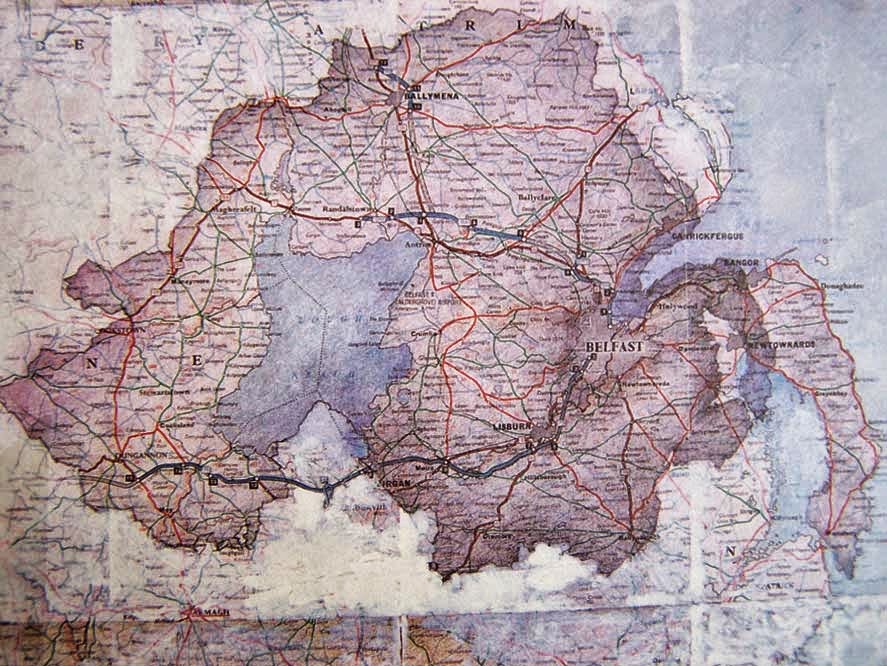 |
| ©Rita Donagh - Shadow of the Six Counties |
U.K. blogger, Eirene, on her blog A Place Called Space visited the Hugh Lane City Art Gallery in Dublin in 2013 and saw Rita Donagh's work there. The following is a photo from her blog and her description of this work:
 |
©Rita Donagh - Bystander
|
"The 'Troubles' in Northern Ireland in the 1970s and 1980s provide the context for Donagh's Bystander. This work is part of a series she made under the general title Disturbance. In this painting Donagh's depiction of Ireland is that of a country that has been stunned by an excess of death, grief, repression and fear. Northern Ireland has become a strangely glacial region where universal whiteness descends threatening to extinguish everything in sight. Two press photographs, modest in their proportions, testify to events in the region. The one on the top left hand side is a newspaper photograph of children playing in an urban wasteland surrounded by dereliction. The second one is of a woman who was killed, caught in the middle of an urban battle: there were no blankets left to cover her body with, as so many had been killed, so her body was covered with newspapers. The rest of the canvas is abstract, large areas where oil and pencil are used - a horizontal bar near the base of the picture contributes to a feeling of constriction. There are areas of murky grey at the top of the painting, evoking an overcast sky and diagonal lines lash through the composition reminiscent of wind-driven rain. This is a painting about violence and loss and it's incredibly powerful."
That is all I have for today. I hope you make time for incredible creativity and follow what ever it is that exists in your heart for the making.
I also want to thank all of the readers of my blog. As of today there have been over 4,000 page views of my 120 posts to date. Thank you.
I also want to thank all of the readers of my blog. As of today there have been over 4,000 page views of my 120 posts to date. Thank you.
'Til tomorrow!
~Alex
Wednesday, November 5, 2014
Jay Defreo's Rose
For eight years it was pretty much all she worked on at an apartment in San Francisco she shared with her husband. She loved to entertain and share her life with the other Beat Scene artists of the time and the legend of the painting travelled to the east coast and her work was included in a show curated by Dorothy Miller in 1959 called "Sixteen Americans."
DeFreo did not attend the show and neither did her monumental painting which eventually had to be removed from the apartment along with part of an exterior wall - by a crane - when a rent increase meant eviction for the artist and her husband, Wally Hedrick.
 |
| Jay DeFreo working on The Rose in San Francisco by Jerry Burchard |
The Rose eventually ended up in a conference room at the San Francisco Art Institute (eventually covered by a false wall) to later be removed and restored after her death from lung cancer in 1989.
Last year there was a retrospective of her work at The Whitney Museum of American Art.
 |
| Jay DeFreo's The Rose at The Whitney Museum of Modern Art photo by Philip Greenberg for The New York Times |
Much of her artwork is held in The Jay DeFeo Trust which she set up before her death. This site shows photos of much of her work over the years; many of the photos she created in the 1970's; The Loop Series, Tripod Series, Shoetree Series, Compass Series, and some of her paintings from the 70's, Lotus Eater and Cabbage Rose. And her work in the 1980's; Eternal Triangle, Summer Landscape, Impressions of Africa, Samurai, La Brea, Mirage, Blue Nile and Black Canyon... and more.
She created for herself and for no one else and I love the authenticity of it.
Tomorrow I'll be talking about British artist, Rita Donagh.
I hope you are enjoying your day.
'Til tomorrow!
~Alex
Tuesday, November 4, 2014
Niki De Saint Phalle
I don't know. I'm sure a lot of people may find it shocking. I may be one of them. Here is a schematic of it and an installation view.
 |
| ©Niki De Saint Phalle - Hon en Katedral |
 |
| ©Niki De Saint Phalle - Hon (schematic drawing) |
Perhaps it's my Midwestern conservative upbringing and the fact that there's no head...
Overall though, I like Niki's work. She loved Gaudi, as do I and she did a lot of Gaudi-esk work. Here are more photos. I haven't the time today to write any more, but now you know who Niki de Saint Phalle is, if you never heard of her or her work before. How fun is that? More art history - I love it!
 |
| ©Niki De Saint Phalle - Grotto |
 |
| ©Niki De Saint Phalle - Tarot Garden |
 |
| ©Niki De Saint Phalle - Serpent Tree |
 |
| ©Niki De Saint Phalle - Noah's Ark Sculpture Park |
'Til tomorrow!~Alex
Saturday, November 1, 2014
I can See the Sea
Today, she is considered a site specific installation artist and a sculptor working primarily with stainless steel and pliable materials such as sheets of plastic.
Since she is Brazilian and not even the English version of Wikipedia has information on her, I have had some extra researching to do. There is a very cool video of her work with her narration on You Tube. But it is in Spanish with no subtitling. It's a visually amazing video all the same. If Spanish is one of the languages you know (or even if it isn't) you might want to check that out. There is also an interview about her on Artslant and the Gallery Raquel Arnaud site has an English version of it's page about Freitas and great photos of her works.
Rather than write about her I thought it would be fun to let her work speak for itself - arranged from the 70's to today. I love the forms and color and rhythm and organic shapes in her work today and the way it interacts with the light and flow of the environment and space the works occupy.


© Iole de Freitas-Glass Pieces, Life Slices
Photography 1973-1981
 |
| © Iole de Freitas-Untitled fabric & metal 1992 |
 |
| © Iole de Freitas- Untitled Cloth Object Sheet Metal, Copper wires - 1992 |
 |
| © Iole de Freitas - Untitled 2009 |
 |
| © Iole de Freitas - artist with reinstallation of work outside Açude Museum in the Tijuda Forest, a mountainous hand-planted rainforest in the city of Rio de Janeiro, Brazil - claimed to be the world's largest urban forest. |
 |
| © Iole de Freitas-Documenta 12 Installation 2007 second floor gallery of the Museum Fridericianum |
 |
| © Iole de Freitas - Caho |

 |
| Untitled, ©Iole de Freitas, 2013 polycarbonate printing Green and aluminum, 100m² x 4 m in height, Casa Daros, Rio de Janeiro |
Tomorrow is Inspiration Sunday of course.
'Til then!
~Alex
Thursday, October 30, 2014
Moving Towards Equality
"I believe that gender is a cultural fiction, not a biological given. But while there have been many achievements in the last 20 years, racism and sexism are still rife. . . . Those things have to become detached. But until we are able to detach gender from the ways we are in the world, it’s important for us to move towards equality. Moving towards equality is what the word feminism means. Until we’ve achieved that, we can’t give up the word. Feminist design is an effort to bring the values of the domestic sphere into the public sphere; feminist design is about letting diverse voices be heard through caring, relational strategies of working and designing. Until social and economic inequalities are changed, I am going to call good design feminist design." ~Sheila Levrant de Bretteville (in an interview with Ellen Lupton, Eye Magazine, Issue 8, 1992)I agree with Sheila Levrant de Bretteville that gender is a cultural fiction. A short way of saying that treating someone differently because of their gender has been invented by culture.
 |
| Sheila Levrant de Bretteville, Pink, 1973, installation photo by Brian Forrest the at WACK! Art and the Feminist Revolution Geffen Contemporary MOCA March 4-July 16, 2007 |
 |
| ©Sheila Levrant de Bretteville-Biddy Mason Wall in LA |
"I will never, never, never forget to include people of colour, people of different points of view, people of both genders, people of different sexual preferences. It’s just not possible any more to move without remembering. That is something that Modernism didn’t account for; it didn’t want to recognise regional and personal differences. People who have given their whole lives of supporting the classicising aesthetic of Modernism feel invalidated when we talk about the necessary inclusiveness, but diversity and inclusiveness are our only hope. It is not possible any more to plaster over everything with clean elegance. Dirty architecture, fuzzy theory and dirty design must be there."Here is another quote I really liked from the interview with Ellen Lupton:
©Sheila Levrant de Bretteville-NY Subway

"There is a prevalent notion in the professional world that only if you have eight or more uninterrupted hours per day can you do significant work. But if you respond to other human beings – if you are a relational person – you never really have eight uninterrupted hours in a row. Relational existence is not only attached to gender by history – not by genes, not be biology, not by some essential ‘femaleness’. A relational person thinks about other human beings and their needs during the day. A relational person allows notions about other people to interrupt the trajectory of thinking or designing . . . . The kinds of work habits that are part of this public sphere – that deny relational experience – are precisely the ones I want to challenge. Feminism has allowed me to challenge them; thinking about myself as a woman has allowed me to challenge them. When women are in the workplace, women do as the workplace demands it. Part of feminism is about bringing public, professional values closer to private, domestic values, to break the boundaries of this binary system."There is a lot to know about Sheila Levrant de Bretteville - much more than I have time to write about here. I had fun researching her art and philosophy and life today.
Here is another transcribed interview in a Yale magazine that is really good too.
Hope you are enjoying this last Thursday before daylight savings goes to winter on Sunday.

'Til Tomorrow!
~Alex
Wednesday, October 29, 2014
Tee Corinne
I think of Corinne as more of a writer type artist than a visual type artist. Much of her visual artist work was photography and photographs manipulated in Photoshop.
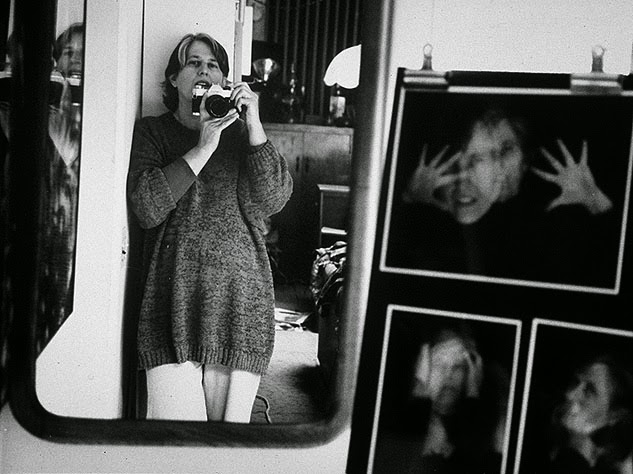 |
| ©Tee Corinne- Self Portrait at 46 |
She used color in her Photoshop manipulated work to convey emotion and mirroring in her earlier photos for visual interest...as I think she was making erotic art but wanted it to be esthetically pleasing - as opposed to pornographic. She also wanted to protect the identities of her models.
 |
| ©Tee Corinne |
I don't know if this was her intent but perhaps she was trying to make society face the physicality of all woman, not just what is considered most appropriately beautiful by some or "the media."
It could be that if we can look more easily at every body than perhaps we can see more easily that we are not that exterior - but are - instead, what resides inside.
If you are interested in more information about Tee Corinne, here is a link to the transcript of an interview she did with Barbara Kyne.
Hope you are having a good Wednesday.
'Til tomorrow!
~Alex
Tuesday, October 28, 2014
The Artist is a Lonely Person
 |
| From the DAN Galeria exhibition: ©Lygia Clark, 1960 |
 |
| ©Lygia Clark-bisos |
Lygia Clark took the idea of touching artwork to a whole new level and even believed that her art could improve the human condition.
 |
| ©Lygia Clark - Canibalismo |
 |
| ©Lygia Clark-The I and The You |
 |
| ©Lygia Clark-Sensorial Mask |
'Til tomorrow!
~Alex
Sunday, October 26, 2014
Inspiration Sunday
And, I thought I'd put in a joke today...just because. :)
It's an old joke.

"Be industrious: the more one works, the better one succeeds. The harder the task, the more honorable the labor. The more a man praises himself, the less inclined are others to praise him." ~Theresa Hak Kyung Cha-Dictee Opening pg 8
"I don't know if I am that conscious of it, but some people say that our films have a tendency toward dirty laundry. The films say it like it is, rather than how people want it to be. Maybe it is my character that tends to want to do that, because I think the visual arts [artist?] in me wants to say the same kind of thing. So I don't know if I consciously did it; I think it is just my own spirit." ~Camille Billops
 |
| The Stone House, a Blues Legend A merger of art, prose and poetry illustrator Camille Billops |
"It murmurs inside. It murmurs. Inside is the pain of speech the pain to say. Larger still. Greater than is the pain not to say. To not say. Says nothing against the pain to speak. It festers inside. The wound, liquid, dust. Must break. Must void." ~Theresa Hak Kyung Cha-Dictee Opening pg 3
"Everybody has a form of tribalism. My sister got the look from Black men because she had a Puerto Rican boyfriend. If she were on the street with two little nasty children needing a daddy, they wouldn’t pay attention. It’s male tribalism that sees women as property." ~Camille Billops
"I would like to be cast as a humanist, someone who made a statement that was relevant to art history and the way we perceive ourselves and things." ~Lynda Benglis
 |
| ©Lynda Benglis |
"When I was in Berkeley everybody was carrying a little red book—Mao's red book—and when Warhol produced his portrait series of Mao in a very aestheticized way, it was a shock—a good shock." ~Dara Birnbaum
"Things happen in this country because you’re dark. Not necessarily because your hair’s nappy, but because you’re dark. That’s the first thing they see. . . .It will be hard to say, “I’m just a person.” No, you don’t get to be “just a person” here, you have to have a camp. And if it’s going to be with white people, you have to really be white. Nothing funny here. See, with Black America, there’s a legal definition. 1/32 Black blood, that means a great, great-grandmother Black—you are Black. That is only in this country, because of slavery. . . . From what I’ve seen in other cultures of color, very similar systems are at work. It’s racism within the group and that’s very powerful. So white people are not the only players on the stage. If you don’t admit to your own racism, how do you expect to keep telling white people about theirs?" ~Camille Billops
"From the "Woodstock Nation" on, there was a brief moment when you actually felt that a large alternative group existed—that there were millions of "us" out there. But this was incredibly idealized. . . . I can remember Tom Wolfe lecturing . . . .It was a turnoff to see the author of Radical Chic in a totally white suit that looked so elitist to us, especially because he then represented the total opposite of a blue-collar worker. And he said, "You think that you are so different. Look at you. You are all so alike—what you are reading, how you are dressing." The coding within that "alternative" society was as defined and strict as in the society we were rejecting." ~Dara Birnbaum
"All work is some form of sensitizing oneself to the environment. It causes us to recognize ourselves and become self-conscious. We perceive in many different levels all at the same time. You can’t divide the intellectual and the sensual." ~Lynda Benglis
 |
| ©Lynda Benglis-North South East West Irish Museum of Modern Art in Dublin |
"She says to herself if she were able to write she could continue to live. She says to herself if she would write without ceasing. To herself if by writing she could abolish real time. She would live. If she could display it before her and become its voyeur." ~Theresa Hak Kyung Cha-Dictee pg. 141Tomorrow is Monday and I am finding that Monday is a very busy day normally. If I have time I will post - if I don't (like last week) I won't. But I will post for sure on Tuesday.
'Til then!
~Alex
Subscribe to:
Posts (Atom)