Wednesday, October 15, 2014
Who Are You?
Who are you and how are you defined and who defines who you are and why?
You decide (maybe you decide and maybe someone else decides) and then you can be that. Buy the clothes, listen to the music, drive that type of car and live...there.
If you were standing there in those boots with the others in those other boots, who would you be?


 |
| Eleanor Antin - Carving-A Traditional Sculpture (1972) |
 |
| Eleanor Antin as Eleanora Antinova from "The Ballerina and the Poet" |
These are the questions Eleanor Antin's art works make me think of.
Here is a video of an interview with her (brief) and also her documentary fiction of Eleanora Antinova from the Archives of Modern Art-West Coast Video Art-MOCAtv
Published on Oct 15, 2012. Eleanor Antin uses fictional characters, autobiography, and narrative to invent histories and explore what she calls "the slippery nature of the self." In her video works, Antin uses role-playing and artifice as conceptual devices, adopting archetypal personae—a ballerina, a king, a nurse—in her theatrical dramatizations of identity and representation. In this work of documentary fiction, an archivist attempts to put together the "lost years" of Eleanor Antinova, the once-celebrated black ballerina of Diaghilev's Ballets Russes, when she returned to her native America to eke out a meager living in vaudeville and early cinema. Interview directed and edited by Peter Kirby. Music: "Lieder ohne Worte, Op. 62, MWV U161: No. 6, Allegretto grazioso" by Saulis Dirvanauskas
Hope you have enjoyed your mid-week blog today. :)
'Til tomorrow!
~Alex


Tuesday, October 14, 2014
Hydragrammas in Malta
It's interesting that while I have been educating myself art and art history and artists how much I've been learning. It is fun to share it too and since over three thousand page views have occurred on this blog since I have started it, I figure I'm sharing all this with at least a few people.
If you have read anything this past week you know I've been researching each artist listed as having been in the WACK! Art and the Feminist Revolution show in 2007.
I wonder how many people are turned off by the word "feminist" these days? I wonder how is it defined...
Feminism: (Wikipedia definition) Feminism is a collection of movements and ideologies aimed at defining, establishing, and defending equal political, economic, cultural, and social rights for women. This includes seeking to establish equal opportunities for women in education and employment. A feminist advocates or supports the rights and equality of women.
Okay. I wonder how many people (worldwide) can claim to be a feminist? There is an interesting feminist e-zine online...I found it taking a peek to see if there was any good stories about Islamic feminism and found this written by Caryle Murphy.
That was fun. But. Why have I travelled (in my imagination) to Malta and the National Museum of Fine Arts this morning?
 |
| National Museum of Fine Arts-Malta photo by |
Sonia Andrade is a Brazilian artist and finding information about her is a bit tricky (because I am in the U.S. trying to find out information about her and she is Brazilian and so much written about her is in Spanish...). She is considered a "video artist" but she does other types of art too so I have been trying to find out what I can.
Her art is categorized as "Conceptual Art" and she is a pioneer of video art and was in a "groundbreaking exhibition" - the first for video art in Brazil - so I can see why she was included in the WACK! show as an important artist to have there.
From the CLARA Database for Women Artists (yes, this is a fabulous site!) it says:
The work of Brazilian installation artist Sonia Andrade explores the relationship between the spectator and the object through the medium of single-channel video. While her installation pieces also include drawings, photography, objects, and postcards, the use of video allows Andrade to exploit the standardized visual system perpetuated by mass media images. The humor and political commentary which Andrade incorporates into her video work provides a powerful critique of modern media culture.In a more recent article in the Rio (de Janeiro) Times - 2011 - Andrade is described as "one of Brazil’s most important and internationally recognized artists" in this story (by Saira Ansari) which was written to cover a retrospective show of her works given at the Municipal Art Center Hélio Oiticica.

In this story, Saira Ansari mentions that Andrade's Hydragrammas were "presented originally in 1993 at the National Museum of Fine Arts. Where is that? ...I wonder
 |
| Parte da série “Hydragrammas”: inventário arquetípico da arte - photo from Daniela Name's wordpress blog I wish I could translate it... |
Tomorrow I will be learning about Eleanor Antin. I hope you will too. :)
'Til then!
~Alex
Monday, October 13, 2014
Hear Me - the art of Helena Almeida
Well, hello there.
Chantal Akerman was next on the list of artists represented in the show WACK! Art and the Feminist Revolution in 2007.
Was?
I know. I said I'd be talking about all the artists that were represented at the show. However, she is a filmmaker and, while I do think film making is (or can be) art, it is not the type of artist that I wish to discuss in my blog because it is a whole huge wonderful topic in and of itself...and it is, in many ways, a bit of a different business type in the art world.
If you want to read more about Chantal Akerman you might read this microsite webpage published by the Vancouver Art Gallery.
So, after Chantal Akerman, next on the list of artists is Helena Almeida, who is Portuguese and uses the images of herself, or parts of herself, in photographs to create her art.
She started painting in art school and had this issue with the 2 dimensionality of canvas. It was too limited for her and she responded to that limitation by using photographic images in very imaginative ways. She is in all of her artworks but not as "herself" but rather as part of the composition itself.
The simplicity of most of the imagery is a fantasy approaching inkblots sometimes. There is color sometimes, but mostly her work is black and white. The format of these is very large.


My favorite written words about this artist were found on the Helga de Alvear Gallery website:
The importance of Helena Almeida's oeuvre lies in the fact that it is impossible to confine the formal traits of her personal language within the fixed bounds of artistic disciplines and classifying labels. While it is true that the Portuguese artist expresses herself chiefly through photography—usually in a large-scale format and a sober black and white, and a sophisticated economy of compositional elements, the truth is that the photographic shot—taken by her husband Artur Rosa, is the last act in a long and rigorous work process involving a large number of preparatory drawings, diagrams and video recordings.
In point of fact her approach to the work of art is characterized by a complex plastic conception born out of an intimate desire to express herself in a “spatial” order—i.e., a need to transcend the limits of the picture. Photography, painting, drawing and performance come together in the unified field of self-representation, where Almeida's body becomes the instrument used to intervene, communicate and create space—both pictorial and architectural—in phenomenological terms.
Phenome.... ?? ..menological ?? What?
Well...
I hope you are enjoying the beginning of the week as much as I am on this sunny fall day.
'Til tomorrow!
~Alex
Sunday, October 12, 2014
Inspiration Sunday
I hope you are having a fabulous end of the week Sunday today. Enjoy!
"There is a kind of anxiety that arises about a separate culture, a separate group. How can we do that to art history? How can we take one half of the population and make it totally separate and different? Well, the point is, at the time in history when these things are subject to finger-pointing, one has to make an educational analysis. But certainly none of us ever wants to live separately. I mean, we just wanted to bring ourselves to the attention of the other gender. And of course, coming back to the discussion of power, we do live in a patriarchy, and the rules are set for us women, and we need to move, to integrate ourselves into the totality of society, and we need to bring our own point of view with us as we do that." ~Miriam Schapiro 1923- (Oral history interview with Miriam Schapiro, 1989 September 10, Archives of American Art, Smithsonian Institution)
Miriam Shapiro / The Twinning of Adam and Eve in the Garden of Eden / 1989 / 80″ x 116″, (triptych) / Acrylic on Canvas / Flomenhaft Gallery

“It is easy to follow, but it is uninteresting to do easy things. We find out about ourselves only when we take risks, when we challenge and question.”
~Magdalena Abakanowicz 1930-
Magdalena Abakanowicz-Coexistence 2002, burlap, resin
group of 14 pieces 175-215 x 58-65 x 60-90 cm

"So women are at the beginning of building a language, and not all women are conscious of it." ~Judy Chicago 1939-
Judy Chicago-Through the Flower 2-1973
Sprayed acrylic on canvas 60 x 60 in.
Collection of Diane Gelon

"Your ego can become an obstacle to your work. If you start believing in your greatness, it is the death of your creativity." ~Marina Abramović 1946-
Marina Abramović

"I see art-making, especially that which comes from the margins of the mainstream, as a site of resistance, a way of interrupting and intervening in those historical and cultural fields that continually exclude me, a sort of gathering of forces on the borders. For the dominant hegemonic stance that has worked to silence and subdue gender and ethnic difference has also silenced difference based on sexual preference." ~Harmony Hammond 1944- (From Women, Art, and Society: Fourth Edition (2007) by Whitney Chadwick)
Harmony Hammond-Affection 1984

"I think the neat thing about my life was that it all started from my experience, and we both know that even if I talk about my intellectual experience or my experience with people—anything outside of my studio—we know that the artist can provide nothing for society unless it comes from within. We really don’t admire artists who ape other artists; we don’t take them seriously. We say, “Ah, yes, we’ve seen this before.” So I think what’s been neat about my life is that I am totally aware that all my experiences come together in the studio, and afterwards I could branch out and share whatever it was that developed from the work in the studio. I could share it with others, and I did that in many, many ways." ~Miriam Schapiro 1923- (Oral history interview with Miriam Schapiro, 1989 September 10, Archives of American Art, Smithsonian Institution)
“I wanted to tell you that art is the most harmless activity of mankind. But I suddenly recalled that art was often used for propaganda purposes by totalitarian systems. I wanted to tell you about the extraordinary sensitivity of an artist, but I recalled that Hitler was a painter and Stalin used to write sonnets...“Each scientific discovery opens doors behind which we are confronted with new closed doors. Art does not solve problems but makes us aware of their existence...” ~Magdalena Abakanowicz 1930-
"I am trying to make art that relates to the deepest and most mythic concerns of human kind and I believe that, at this moment of history, feminism is humanism." ~Judy Chicago 1939-
"Art will remain the most astonishing activity of mankind, born out of struggle between wisdom and madness, between dream and reality, in our mind." ~Magdalena Abakanowicz 1930-
"The function of the artist in a disturbed society is to give awareness of the universe, to ask the right questions, and to elevate the mind." ~Marina Abramović 1946-
That is Inspiration Sunday for this week. Hope you have plans for an extra creative and astonishing week; elevate our minds and ask the right questions :)
'Til tomorrow!
~Alex
Saturday, October 11, 2014
Carla Accardi Day
I am going through the whole list systematically because, otherwise, I may just talk about a few of the artists if I allowed myself to just choose the artists I think I like most. Today is Carla Accardi day. She was born in Italy during war time. Here, I think is a good overview of her - short and sweet which, after researching the history of Mussolini and Marxism in Italy and not really wishing to get into it...I am leaning toward liking best:
Carla Accardi rose to fame as founding member of the 1947 Italian avant-garde movement Forma 1, a group of artists based in Rome who, in the face of Fascism, embraced the principals of Futurism and Marxism. As one of the key figures of abstract art in Italy during the time, Accardi developed an iconic visual lexicon of calligraphic marks that, when combined with her minimalist color palette and dynamic compositions, showcased the endless possibilities of abstraction. In the 1960s, Accardi began painting on Sicofoil, a transparent plastic sheeting used in commercial packaging, instead of canvas. The dynamism in Accardi’s work, as well as her emphasis on non-art materials and simple processes and structures, became a precursor to Arte Povera.Her early paintings were of interlocking geometric forms and she worked to attempt to revolutionize abstraction through the combining of geometric abstraction and gestural painting.
The painters of the "Form 1": Pietro Consagra, Mino Guerrini, Ugo Attardi, Carla Accardi, Achille Perilli, Antonio Sanfilippo and Piero Dorazio
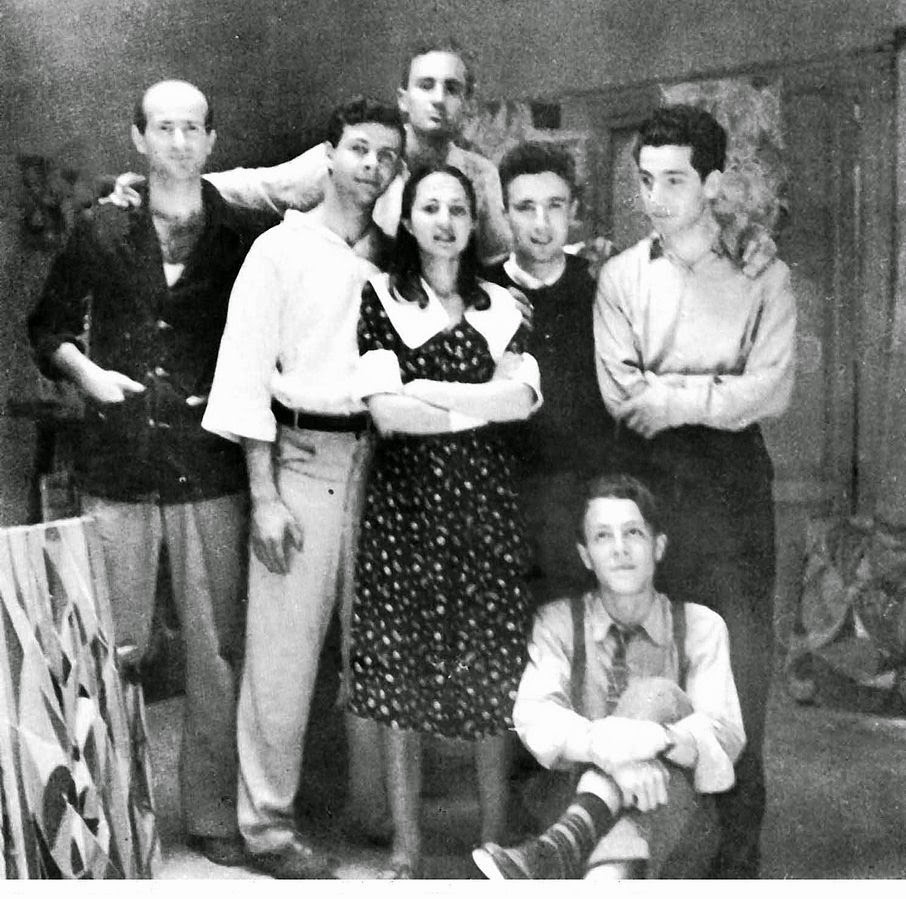
She stopped painting for about a year and then just painted for a while white on black (it was thought this was to explore the relationship between figure and ground).

When she went back to painting, it was with a limited palette (2 colors) and on a plastic material called sicofoil (no longer manufactured) with which she made painted sculptural tent-like forms.


Sometimes the quietest and most unassuming exhibitions turn out to be the most fascinating, if not the strangest.
Tucked away on the third floor of Sperone Westwater’s Bowery building, there’s a show titled Post-War Italian Art: Accardi, Dorazio, Fontana, Schifano. That’s it. No jazzy tagline like “Treasures of Proto-Arte Povera” or “Secrets of Euro-Neo-Pop.” Just Post-War Italian Art: Accardi, Dorazio, Fontana, Schifano.
There isn’t even a press release accompanying the listing on the gallery’s website, which is just as well. It’s a plainspoken exhibition whose strengths are apparent only after a period of unhurried observation, however outmoded that may sound. . . . .
Another artist who deals with the art object — how it is made and perceived — is Carla Accardi, who was born in Sicily in 1924 and now lives in Rome. She has several works here, one more radical than the next.
There is a small, patterned green-on-red abstraction in casein on canvas near the gallery entrance called, appropriately, “Verderosso n. 6” (“Green-red no. 6,” 1964). It’s an intriguing painting, but it doesn’t prepare you for “Bianco oro” (“White Gold”), which she made in 1966, hanging on the other side of the room.

The first thing you notice about “Bianco oro” are the cursive strokes of gold-colored varnish rippling outward from the center of the painting; the second thing you notice is that the brushstrokes are casting shadows on the white canvas, which is wrapped in transparent plastic — a material called sicofoil — upon which Accardi has applied the varnish.
Compellingly, what should by all rights be dismissed as cheap effect instead comes off as weirdly, poetically beautiful. The hovering gold brushstrokes, which grace the plastic with a minimalist purity, assert the painting’s thing-ness while their shadows dissolve our sense of it as a solid object. Yes, it’s a trick, but resistance to its artless radiance is futile.
By the following year the canvas support is gone. In “Segni Verdi” (1967), which can translate as “Green Signs,” “Green Signals,” “Green Symbols” or simply “Green Marks,” the painting’s stretcher bars are visible between the strokes of green varnish, which are brushed on in a diagonal, wavelike pattern.

The result isn’t quite as engaging as “Bianco oro,” perhaps because it is more literal in its approach to unmasking the art object, but its audacious simplicity can be enjoyed as a lyrical answer to Robert Rauschenberg’s Combines, which approach a similarly self-conscious aesthetic with kitchen-sink aggressiveness. (from Alien Skins: Experimental Italian Painting of the 1960's - 2013, Thomas Micchelli).Hyperallergic is a great website for perspectives about art in today's world. I hope you check out their site.
That's all I have for you today. Hope you are enjoying your weekend!
'Til tomorrow!
~Alex
Friday, October 10, 2014
Marina Abramović-Her Body as Medium and Subject
I am going through the whole list systematically because, otherwise, I may just talk about a few of the artists if I allowed myself to just choose the artists I think I like most.
No good. Because, I have found that once I begin to research the artists I find them all very interesting, and this opens my mind to them more and I learn other things along the way too.
Certainly, the curators of the show included each of these artists because they felt their contribution to the history of feminist art was significant. And, as Fran Smith says in her article in Edutopia; Why Arts Education Is Crucial, and Who's Doing It Best:
A 2005 report by the Rand Corporation about the visual arts argues that the intrinsic pleasures and stimulation of the art experience do more than sweeten an individual's life -- according to the report, they "can connect people more deeply to the world and open them to new ways of seeing," creating the foundation to forge social bonds and community cohesion.So, in the interest of creating the foundation to forge social bonds and community cohesion we are going to talk about Marina Abramović today.
 |
| Dozing Consciousness (c) Marina Abramovic |
One of her first installations was the use of her hand and several knives where she recorded the sounds she emitted each time she cut herself and then switched to another knife. Sound pretty weird?
 |
| Rhythm 10 (c) Marina Abramovic |
 |
| Marina Abramovic’ and Ulay, Relation in Time. Originally performed at 1977 for 17 hours at Studio G7, Bologna. Still from 16 mm film transferred to video (black and white, sound), 50:33 min. (c) 2010 Marina Abramovic. Courtesy the Artist and Sean Kelly Gallery/ Artists Rights Society (ARS), New York. |
In a 2011 article written in The Telegraph by Alastair Sooke titled: "Marina Abramovic: 'It takes strong willpower to do what I do’ On the eve of a typically severe new show, performance artist Marina Abramovic explains how her work can change your life." Abramović explains her own art this way:
“What I’m doing is inventing events that I am afraid of. I go in front of the public and, if I can do it, they can do it, too. That’s why performance art – if it’s good – can be a life-changing experience.”
She pauses. “This is the function of an artist. I am not a therapist. I am not a spiritual leader. These elements are in the art: it is therapeutic, spiritual, social and political – everything. It has many layers. But art has to have many layers. If it doesn’t, then forget it.”Well. I agree with that...art has to have many layers.
Balkan Baroque (c) 2010 Marina Abramovic

In case you are taking Marina's artworks too seriously, a visit to this site - created by Scott Indrisek-may just take care of that :) - pretty funny!
Hope you experience many layered art today for yourself.
'Til tomorrow!
~Alex
Thursday, October 9, 2014
Magdalena Abakanowicz, Hitler, and Moms
Imagine this. You're a 9 year old little girl living in a big house with your family, (who happens to be quite comfortably wealthy) and one day, the city you live in is invaded, your home is seized and burned, and your mother is shot dead in front of you.
I'm going to talk about each of the artists in the WACK! Art and the Feminist Revolution show by alphabetical order. Doesn't that sound orderly? :) and Magdalena Abakanowicz is first on our list.
Magdalena Abakanowicz was born in Poland in 1930 and was 9 years old when Poland was invaded by the Nazis.
You see? Back in 1938 Hitler wanted Poland as a continuation of his expansion efforts that started with the lands bordering Czechoslovakia and Germany (then called Sudentenland), and then Czechoslovakia itself in 1939. He managed to get away with this without causing any hostilities with the two superpower countries at the time. Ah. That would be the United States and the Soviet Union.
I need a map.

There. I feel much better now.
Anyway. In his infinite wisdom, ol' Adolf thought to himself. "My people need to stretch out some more. I think Poland would be a nice addition to my collection. And, after all, the native Slavs (which should make nice slaves) aren't really people and all...."
Oh. No...that's not exactly it. He felt that the Germans were "racially superior..." and in the hopes of going unnoticed about his little takeover of Poland, he got some Nazi S.S. troops to dress up as Polish soldiers and stage a mock invasion of Germany and publicized the "Polish attack" as an "unforgivable act of aggression" so he could call his invasion a "defensive action."
Had Hitler's mother still been alive I don't think she would have been particularly proud of this sneaky tactic - but it has been argued that the way she died was one of the reasons he was...the way he was...as if such evil could be explained away somehow. But don't we humans always try to make sense of things?
Let us pause for a moment and think about what is happening in the world at the moment and think about the saying; "history repeats itself."
How about another map?

Hmmm.
Well.
Back to Magdalena Abakanowicz.
 |
| 80 BACKS 1976-80, burlap and resin life size h. 61-69 cm; depth 50-56 cm; width 55-66 cm collection: Museum of Modern Art, Pusan, South Korea |
Poland was a politically volatile country where instability was a permanent state. She has learned to escape to her corner, to make the best of things, to use whatever was viable and even to make gigantic works in a tiny studio. Her art has always addressed the problems of dignity and courage. This dignity resistance and will of survival conceal her individual personal affinities to the culture of Poland, the country where she has grown up, to this country’s political situation, and to the realities of existence of an artist, an intellectual.The metaphoric language of her work has achieved a point of junction, which still is a challenge for mankind, for all its sophisticated civilization. This is the point where the organic meets the non - organic, where the still alive meets that which is already dead, where all that exist in oppression meet all that strive for liberation in every meaning of this word.
DANCING FIGURES
2001/2002, bronze
7 figures
each ca 165 x 150 x 55 cm
AGORA
2005-2006, iron
106 figures 285-295 x 95-100 x 135-145 cm
Permanent installation in Grant Park, Chicago


 |
| SEATED FIGURES 1974-79, figures: burlap and resin, pedestal: steel Eighteen pieces, each figure ca. 104 x 51 x 66 cm each pedestal: 76 x 46 x 22 cm whole sculpture: 145 x 47 x 75 cm Sydney Lewis Collection, Richmond, Virginia Second group in Muzeum Narodowe, Wroclaw |
'Til tomorrow!
~Alex
Subscribe to:
Posts (Atom)