Sunday, November 16, 2014
Inspiration Sunday
A busy life made busier making sure a new life didn't turn into a popsicle. But today? Glorious! The sky is once again that special Colorado blue. You don't see that color anywhere else. Of course it's still only 7 degrees outside. . . but it's going to get better every day.
Hope these quotes are so inspiring that we get a whole lot of creative juice flowing this week! Enjoy :) Since I've been researching a lot of artists who's work is more abstract - most of today's quotes reflect that.
What experience has shown me is that it takes your life to become an artist. ~Eric Fischl
©Eric Fischl - Booth #1 Oldenburg’s Sneakers

'Realism' has been abandoned in the search for reality: the 'principal objective' of abstract art is precisely this reality. ~Ben Nicholson
©Ben Nicholson - Elephantine

What does that represent? There was never any question in plastic art, in poetry, in music, of representing anything. It is a matter of making something beautiful, moving, or dramatic - this is by no means the same thing. ~Fernand Leger
©Fernand Lager - A Vision of the Contemporary City

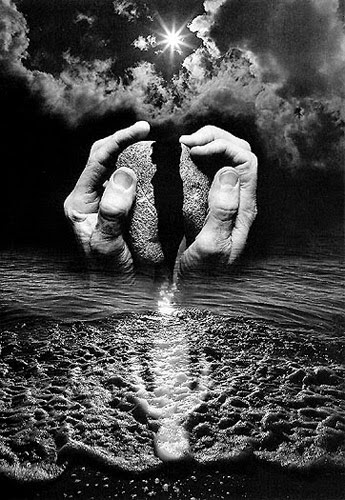
In the arts there are many right answers. I've learned over the years that when you get a clue to another possibility to follow it through . . . . Ultimately, my hope is to amaze myself. ~Jerry Uelsmann
©Jerry Uelsmann - Untitled 1987
The trouble with recognizable art is that it excludes too much. I want my work to include more. And 'more' also comprises one's doubts about the object, plus the problem, the dilemma of recognizing it. ~Philip Guston
©Philip Guston - Head and Bottle

So now the floodgates are open to the delight of pure form, whatever its origin. Anything goes. ~Philip Johnson
Philip Johnson's Glass House

Abstract expressionism was the first American art that was filled with anger as well as beauty. ~Robert Motherwell
© Robert Motherwell - Black on White

If you make pictures you are bound to be an abstract painter on some level. ~George D. Green
©George D. Green - Bones

Be guided by feelings alone. . . . Before any site and any objects, abandon yourself to your first impression. If you have really been touched, you will convey to others the sincerity of your emotion. ~Jean-Baptist-Camille Corot
©Jean-Babtist_Camille Carot - Pâturage dans les marais

When you see a fish you don't think of its scales, do you? You think of its speed, its floating, flashing body seen through the water. Well, I've tried to express just that. If I made fins and eyes and scales, I would arrest it movement, give a pattern or shape of reality. I want just the flash of its spirit. ~Constantin BrancusiWishing you a wonderful (and warm) week this week. I'll be back as soon as I can with another artist from the WACK show.
©Constantin Brancusi - The Kiss

'Til then!
~Alex


Wednesday, November 12, 2014
Louise Fishman
Our weather has gone from nice to ice in no time. A few days ago it was 64 degrees outside. Right now it is -1. No. You did not hallucinate the minus sign there. It could be worse. There could be more than an inch of snow on the ground in the bargain...something a lot of people in the Midwest are dealing with at the moment. All I can say is...brrrr!
And. Be careful out there.
I have been thinking about writing this post for the last couple of days when I have managed to brave the window. The artist I have been researching is Louise Fishman. There is an interview out on the web (Oral history interview with Louise Fishman, 2009 Dec. 21, Archives of American Art, Smithsonian Institution) that has a lot of information about Louis Fishman's life and work. The following are some quotes from that interview along with some images of Fishman's work:
". . . . I was the only real painter-painter. I was doing traditional painting. I didn't understand what the connection was, but I liked it being in that context, because I think that I get misplaced a lot of times. People . . . . they think of me as being very traditional. I think I'm really not . . . . they always link me to Joan Mitchell and Bill Jensen now . . . . there are connections, but that's sort of a dead end in a way. It feels like it."
 |
| ©Louise Fishman - Untitled 1971 |
"I seem to start a group of [paintings] and go back and forth for a while. And then usually one painting becomes prominent in my mind, and then I often put the others away for a while or stop working on them. Sometimes I have to put them away so I don't look at them much. And I continue working on one. And then I need a break. I bring another one out, and I go back and forth a little bit until - yes, so there is a kind of - a little bit of a dialogue between them."
 |
| ©Louise Fishman - Angry Paintings 1973 |
 |
| ©Louise Fishman - Tabernacle 1981 |
"The way I choose color is really like, how I'm going to use this and this, that. A lot of colors sort of come together from one painting to another. And it's just like a buildup. It's almost like adding clay, and it keeps changing. The color keeps changing. And - but I'm not relying on that black and white or that value structure the way I used to and the color was really just an addendum. The color is more on its own, or the hues are more complicated. There's more complex meaning in them in the way they interact with the whole. They are taking more of a place. They have their own identity."
 |
| ©Louise Fishman - Slippery Slope 2006 |
"It's all like a chain of things . . . . it's sort of my interest in those Native American cultures, the architecture; the space is the sipapu and the mountain - the Navajos living right up against the mountain, the whole business about rocks and the mountains. . . . . and a lot of it came from China, the ideas about the mountain. I, you know, think it's Eastern, all that continents moving apart and so on. So it made a lot of sense to me."
 |
| ©Louise Fishman - Night Shining White 1998 |
"Well, a lot of people have referred to me, and actually, they think they're quoting me in saying that I'm a second-generation or third-generation Abstract Expressionist . . . . I never said that. Somebody else said it, and somebody quoted it. And it just got carried down . . . . And I never knew how to go about correcting that. But that's not true. I don't think of myself as an Abstract Expressionist. I think that I have roots there. I have roots in Cezanne. I think I have roots in a lot of places . . . ."
 |
| © Louise Fishman - Wintereisse 2002 |
". . . . Easier and harder. What's easier is my skill level. What's harder is to - skill is less and less useful in terms of what makes a good painting, for me, and probably for a lot of people, because it's not about making beautiful paintings. It's about something else. It's about making something that really has a life and has something that's inspiring. I don't really know how to talk about it exactly, but it's that. It's like, hey, yeah, well, it's rough, but it's so deep to me. One painting, Cooked and Burnt [2007], it was called, and I thought, that's really good. It is really - I'm happy I did that. It just felt - it had everything in it. It was not a beautiful painting. It was just so real somehow."
 |
| © Louise Fishman - Cooked and Burnt 2007 |
"TM [Transcendental Meditation] was just like a way of calming myself down and centering myself. . . . .I started going on retreats. . . . .I think a lot of artists have done that, because it's a very dicey life. I mean, all of our lives are dicey. But I think making art and trying to survive emotionally, the people, the world, and your work, all of that is - and we tend - I think probably most of the artists tend to be - to have their own fragility that's - I don't know if it's more than other people, but I know that there is a fragility in there. And . . . . one has to keep a balance of the unsettled stuff. It has to be there. You can't fix it. It's just what it is."
 |
| ©Louis Fishman - Troubles Overcome are Good to Tell 1997 |
"I don't do drawings or prints with the intention of making a painting from them, ever. But they find their way later. Often it's stuff I wouldn't do in painting yet, because there's - it's easier to throw color into them. It's easier to have new, kind of, configurations in them. And they may occur in paintings and they get painted out, but - and then they'll show up. So I noticed that that process really does affect the paintings later. And they are - there is a freshness, and there's stuff that comes up in the drawings that shows other parts of my work that I think could shed light on what the paintings are about and not what people often think they're about."
 |
| ©Louise Fishman - Untitled 2011 from the Venice Watercolors |
'Til tomorrow!
~Alex
Sunday, November 9, 2014
Inspiration Sunday
I have quotes today from Rollo May from his book The Courage to Create mainly from the chapter, Creativity and the Unconscious. And, I have some interesting art to accompany these quotes today. Perhaps to pose the question; can meaningful art and dogmatism co-exist?
genuine artists are so bound up with their age that they cannot communicate separated from it. In this sense, too, the historical situation conditions the creativity. . . . "Creativity," to rephrase our definitions, "is the encounter of the intensively conscious human being with his or her world."
A dynamic struggle goes on within a person between what he or she consciously thinks on the one hand and, on the other, some insight, some perspective that is struggling to be born.
Carl Jung often made the paint that there is a polarity, a kind of opposition, between unconscious experience and consciousness. He believed the relationship was compensatory: consciousness controls the wild, illogical vagaries of the unconscious, while the unconscious keeps consciousness from drying up in banal, empty, arid rationality.
The moment the insight broke through, there was a special translucence that enveloped the world, and my vision was given a special clarity.
Kim Jong-un

This is one aspect of what is called ecstasy--the uniting of unconscious experience with consciousness, a union that is not in abstracto, but a dynamic, immediate fusion.
. . . . insight comes at a moment of transition between work and relaxation. It comes at a break in periods of voluntary effort.
 |
| Stalin |
The experience that "this is the way reality is and isn't it strange we didn't see it sooner" may have a religious quality with artists. This is why many artists feel that something holy is going on when they paint, that there is something in the act of creating which is like a religious revelation.
[if we] lose this free, original creativity of the spirit as it is exemplified in poetry and music and art, we shall also lose our scientific creativity. Scientists themselves . . . . have told us that the creativity of science is bound up with the freedom of human beings to create in the free, pure sense.
Franco

Just as the poet is a menace to conformity, he is also a constant threat to political dictators. He is always on the verge of blowing up the assembly line of political power.
Chavez

Dogmatists of all kinds - scientific, economic, moral, as well as political - are threatened by the creative freedom of the artist. This is necessarily and inevitably so. We cannot escape our anxiety over the fact that the artists together with creative persons of all sorts, are the possible destroyers of our nicely ordered systems. For the creative impulse is the speaking of the voice and the expressing of the forms of the preconscious and unconscious; and this is, by its very nature, a threat to rationality and external control.

Hope your Sunday is everything you want it to be. I will see you tomorrow or Tuesday, depending on how much I have stacked up tomorrow.
'Til then!
~Alex
Friday, November 7, 2014
Will Art Change Anything?
Kirsten Dufour, Lili Dujourie, Rose English and VALIE EXPORT.
I'm sure as I go along down the list of artists in the show that there will be more. But right now I am only to the F's.
Today I will talk about New Zealand artist, Jacqueline Fahey. She is a painter and a writer. And, regardless of the fact that she was in the WACK! Art and the Feminist Revolution show in 2007, she doesn't consider herself to be a feminist.
She is, at the age of 85, very outspoken and direct about how she feels about art and humanity and most everything. I watched an interview on the New Zealand Cultural Icons website with her and have quoted some of that interview.
Painting and writing are equal in their power of addressing social issues she believes and says that they can be powerful as long as you "communicate in a way that is patently sincere."
She is asked about why she paints domestic scenes (her critics will describe her art as "domestic art" sometimes apparently) and she says:
"My belief was at the time I was at art school woman artists would go to a great deal of trouble to get out get in the car and "do landscape", you know? And not paint what was their own reality because that reality was so diminished. I mean. A man could paint that and it wasn't called 'domestic art' . . . . But when I did it - it was called 'domestic art' which was a put down."
 |
| ©Jacqueline Fahey - Last Summer |
"The use of paint is a powerful language in its own right and that is what I am looking for. . . . that flat filling in type painting is amateur really . . .(interviewer prompts "so the paint has to be really alive - resonant?") Yes and how you make the strokes has an energy to it and implies something, you know? it is - in itself - doing that."
 |
| ©Jacqueline Fahey - Emily as the Archangel Gabriel |
"No. I don't think you should separate "feminist" in that sense. I don't like it. I think it gives a lot of women who say they're feminists a hero - when in fact they shouldn't have - because. Look. They don't give a shit about some poor bloody Asian immigrant working with sometimes nasty Indian management who have no "real" rights, who're paid a pittance - you know? Do they have any interest in that? No. . . . . Feminism [for some feminists] has no meaning because they only meant it for them - they didn't mean it for anyone else. And [if you were to point this out] . . . . they would look at you as if you were speaking a foreign language."She is asked will there always be painting? "I think there will always be painting because painting communicates and anything that communicates will last."
 |
| ©Jacqueline Fahey - Will Painting Change Anything? |
Hope you are having a lovely day!
'Til tomorrow!
~Alex
Thursday, November 6, 2014
The Troubles and Rita Donagh
And it has. The artist who is the subject of this blog today, Rita Donagh, is a bit of a mystery to me though. I can't figure out why she was in a feminist show, particularly. Maybe if you know why she might have been included, other than because she was a woman, you could comment on that below.
The majority of her art was inspired by the Northern Ireland Conflict, euphemistically called the Troubles, that started in the 1960's and didn't "end" until the 1990's.
 |
| ©Rita Donagh - Counterpane |
I appreciate art that addresses the history of war. This is because of how were are led to know and remember things. I believe that events in time, before history is born, are remembered differently by anyone present; remembrance is colored of course by opinion, level of involvement, the coping mechanisms of the person, and so much more.
 |
| ©Rita Donagh - Single Cell Block |
Especially when a collective of humans are exposed to the atrocities of war...which in this case is still being called "Conflict", the facts human kind does not wish to remember (because of shame and/or fear of a tarnished legacy ...or whatever) are subverted, rewritten or ignored.
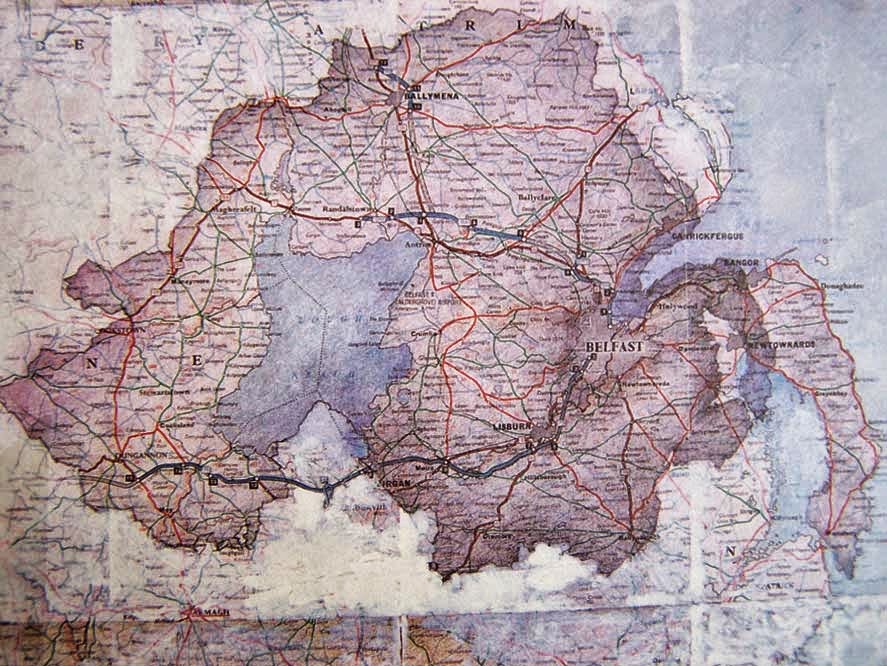 |
| ©Rita Donagh - Shadow of the Six Counties |
U.K. blogger, Eirene, on her blog A Place Called Space visited the Hugh Lane City Art Gallery in Dublin in 2013 and saw Rita Donagh's work there. The following is a photo from her blog and her description of this work:
 |
©Rita Donagh - Bystander
|
"The 'Troubles' in Northern Ireland in the 1970s and 1980s provide the context for Donagh's Bystander. This work is part of a series she made under the general title Disturbance. In this painting Donagh's depiction of Ireland is that of a country that has been stunned by an excess of death, grief, repression and fear. Northern Ireland has become a strangely glacial region where universal whiteness descends threatening to extinguish everything in sight. Two press photographs, modest in their proportions, testify to events in the region. The one on the top left hand side is a newspaper photograph of children playing in an urban wasteland surrounded by dereliction. The second one is of a woman who was killed, caught in the middle of an urban battle: there were no blankets left to cover her body with, as so many had been killed, so her body was covered with newspapers. The rest of the canvas is abstract, large areas where oil and pencil are used - a horizontal bar near the base of the picture contributes to a feeling of constriction. There are areas of murky grey at the top of the painting, evoking an overcast sky and diagonal lines lash through the composition reminiscent of wind-driven rain. This is a painting about violence and loss and it's incredibly powerful."
That is all I have for today. I hope you make time for incredible creativity and follow what ever it is that exists in your heart for the making.
I also want to thank all of the readers of my blog. As of today there have been over 4,000 page views of my 120 posts to date. Thank you.
I also want to thank all of the readers of my blog. As of today there have been over 4,000 page views of my 120 posts to date. Thank you.
'Til tomorrow!
~Alex
Wednesday, November 5, 2014
Jay Defreo's Rose
For eight years it was pretty much all she worked on at an apartment in San Francisco she shared with her husband. She loved to entertain and share her life with the other Beat Scene artists of the time and the legend of the painting travelled to the east coast and her work was included in a show curated by Dorothy Miller in 1959 called "Sixteen Americans."
DeFreo did not attend the show and neither did her monumental painting which eventually had to be removed from the apartment along with part of an exterior wall - by a crane - when a rent increase meant eviction for the artist and her husband, Wally Hedrick.
 |
| Jay DeFreo working on The Rose in San Francisco by Jerry Burchard |
The Rose eventually ended up in a conference room at the San Francisco Art Institute (eventually covered by a false wall) to later be removed and restored after her death from lung cancer in 1989.
Last year there was a retrospective of her work at The Whitney Museum of American Art.
 |
| Jay DeFreo's The Rose at The Whitney Museum of Modern Art photo by Philip Greenberg for The New York Times |
Much of her artwork is held in The Jay DeFeo Trust which she set up before her death. This site shows photos of much of her work over the years; many of the photos she created in the 1970's; The Loop Series, Tripod Series, Shoetree Series, Compass Series, and some of her paintings from the 70's, Lotus Eater and Cabbage Rose. And her work in the 1980's; Eternal Triangle, Summer Landscape, Impressions of Africa, Samurai, La Brea, Mirage, Blue Nile and Black Canyon... and more.
She created for herself and for no one else and I love the authenticity of it.
Tomorrow I'll be talking about British artist, Rita Donagh.
I hope you are enjoying your day.
'Til tomorrow!
~Alex
Tuesday, November 4, 2014
Niki De Saint Phalle
I don't know. I'm sure a lot of people may find it shocking. I may be one of them. Here is a schematic of it and an installation view.
 |
| ©Niki De Saint Phalle - Hon en Katedral |
 |
| ©Niki De Saint Phalle - Hon (schematic drawing) |
Perhaps it's my Midwestern conservative upbringing and the fact that there's no head...
Overall though, I like Niki's work. She loved Gaudi, as do I and she did a lot of Gaudi-esk work. Here are more photos. I haven't the time today to write any more, but now you know who Niki de Saint Phalle is, if you never heard of her or her work before. How fun is that? More art history - I love it!
 |
| ©Niki De Saint Phalle - Grotto |
 |
| ©Niki De Saint Phalle - Tarot Garden |
 |
| ©Niki De Saint Phalle - Serpent Tree |
 |
| ©Niki De Saint Phalle - Noah's Ark Sculpture Park |
'Til tomorrow!~Alex
Subscribe to:
Posts (Atom)